

Can You Start With One Miner? From Budget and Hosting to Your First BTC
Yes. With a site that accepts one hosted miner, you arrange the budget and agree the service terms while the site handles installation and daily operation. The next questions are how much to pay upfront, what to monitor, when BTC reaches your wallet and how to pay electricity.
We follow one Wukong US S21 XP 270T through the process. The example uses reference figures from a JGM Hub demonstration listing checked September 8, 2026 to help with budgeting. Confirm one-unit availability, the current price and deployment arrangements with the provider in your quote and order.
Prepare the purchase payment and an electricity reserve
The reference price for this S21 XP 270T is 4,050 USDT. Adding a 420 USDT electricity deposit gives 4,470 USDT upfront. Monthly electricity follows, so separate the money needed to start from the reserve needed to keep operating.
Reference machine price: 4,050 USDT
This is the reference amount for one machine. Ask whether freight, installation and deployment cost extra and how machine records are handed over.
Electricity deposit: 420 USDT
The deposit is separate from monthly electricity. Under the published terms, unused deposit is normally returned within 15 business days after service ends and all bills are settled, subject to your agreed terms.
Reserve about 192.60 USDT per 30 days
Estimated from 3,645 W nameplate power, 3% additional power, 95% uptime, actual-use billing and 0.075 USDT/kWh. This is a cash-reserve estimate, not the site invoice.
The 4,470 USDT adds only the machine and deposit in this example. Ask about any other one-time charges and whether the estimated 15-day deployment runs from payment, site arrival or another agreed date.
What do you, the site and JGM each handle?
Under JGM Hub’s published process, purchase funds go directly to Wukong Technology, the site partner; Hub does not collect or hold them. Agree the model, total cost, estimated start date, pool account and payout-address arrangements before ordering so you know who handles each step.
You decide and provide
Confirm the budget and service terms, pay, and provide the agreed account and payout details. Keep the order, machine records and bills for reference.
Wukong Technology handles the site
Supply and deploy equipment as agreed, manage operation, shutdowns, restarts and repairs, and provide electricity billing. The order defines the included services and charges.
JGM and Hub assist
Assist with Chinese-language communication, offer records, deployment follow-up, notices, data checks and resolving issues. The partner handles on-site operation.
Relationship disclosure: JGM Learn and JGM Hub are part of J Global Mining. The example uses Wukong Technology’s US hosting service, and JGM may receive service or advertising fees from partner offers.
After deployment, check that the matching machine name and effective hashrate appear in the pool, then compare the equipment status in Hub. A new start takes time to accumulate data; if hashrate stays absent, ask the provider to check the connection and settings.
Check hashrate, notices and bills
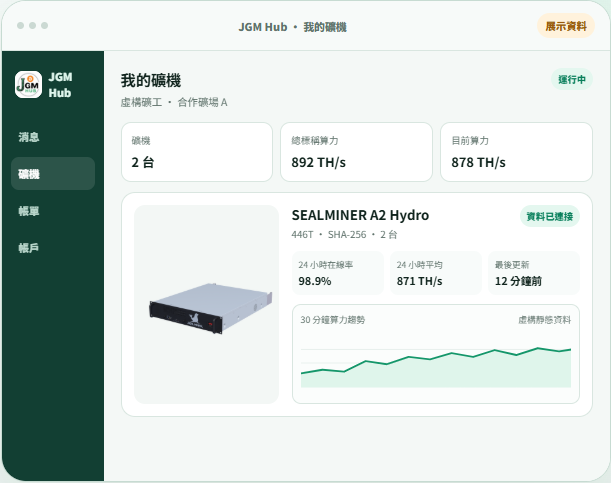
Hub brings equipment, hashrate trends, electricity bills and site notices together. Try the public demonstration to learn what records you would see after buying; its figures are fictional.
Use the demonstration to practice finding a machine, checking hashrate update times, reading billing periods and locating downtime notices.
BTC accumulates in the pool before reaching your wallet
Using F2Pool, listed in the US partnership information, BTC first accumulates in the pool account and is paid to the wallet after the selected threshold is reached. Confirm the account and payout arrangements before startup.
- 01
Accrual: the pool receives effective hashrate
You can first see hashrate and estimated earnings. After daily settlement, the amount enters your pool-account balance.
- 02
Settlement: the previous pool day is finalized
F2Pool settles daily. The pool account shows daily earnings, balance and payout records.
- 03
Payout: funds are sent after the threshold is reached
F2Pool’s default BTC payout threshold is 0.005 BTC and can be changed in account settings. After the threshold is reached, payment follows the pool schedule and blockchain confirmation.
Using September 7, 2026 data, a 4% pool fee and 95% uptime, 270 TH/s accumulates about 0.00012144 BTC per day. Starting from zero with unchanged conditions, reaching 0.005 BTC takes about 42 days. This teaching estimate depends on daily output, the account threshold and payment arrangements.
For the first bill, start with the dates and rate
Under the published terms, electricity is normally billed after month-end using the previous month’s operating records, with payment due within five calendar days. A mid-month start may produce a partial-month bill, so it will differ from the 30-day reserve above.
Reconcile the first bill against three records
- Order: the agreed rate, how energy use is measured, whether line loss is included and how downtime is charged.
- Pool and Hub: the date hashrate actually began, downtime intervals, maintenance notices and recovery time.
- Invoice: billing dates, energy use, rate, and whether the deposit is kept separate from current charges.
If powered hours, power, rate or invoice content is disputed, the published rule requires raising it through Hub within five calendar days of invoice; the undisputed portion remains due. No new electricity accrues after confirmed power-off, but charges incurred before shutdown still have to be settled.
Example and sources
Listing figures illustrate the one-miner budget, operating reports provide past reference data, and payout rules link to the pool’s official documentation. Follow the relevant source for the part you want to check.
- Historical reference: the US air-cooled S21 report, including its effective observation period and shutdown exclusions.
- Case reference: the demonstration listing checked September 8, 2026, including price, deposit, electricity and estimated deployment. A purchase uses the current confirmed terms.
- Teaching assumptions: a 4% pool fee, 3% additional power, 95% uptime, actual-use billing, and USDT/USD treated as 1:1 only for arithmetic comparison; the pool fee is not confirmed for this offer.
View research sources
Sources checked September 8, 2026. Offers and pool rules can change; reopen the sources and obtain current written terms before payment.
- JGM Hub | Wukong US S21 XP reference listing
- JGM Hub | Reference listing data
- JGM Hub Marketplace | Test-environment and manual-confirmation notice
- JGM Hub | Wukong Technology partner site and billing rules
- JGM Hub | Wukong Technology site inspection
- JGM Hub | Full US air-cooled S21 operation report
- JGM Hub | Miner-management demonstration
- F2Pool | Pool essentials, fees and BTC threshold
- BITMAIN | Official S21 XP specifications