

How to Read a Mining Hosting Electricity Bill
You receive an electricity bill for $400.56. Trace how it was calculated from the agreed tariff, rather than judging the total alone. Follow one SEALMINER A2 Pro Hyd from the amount due back to its billable operating hours.
This teaching invoice was prepared on September 11, 2026. Fields draw on the public Hub demo, with separately assumed figures. It contains no customer data and is not a partner quote.
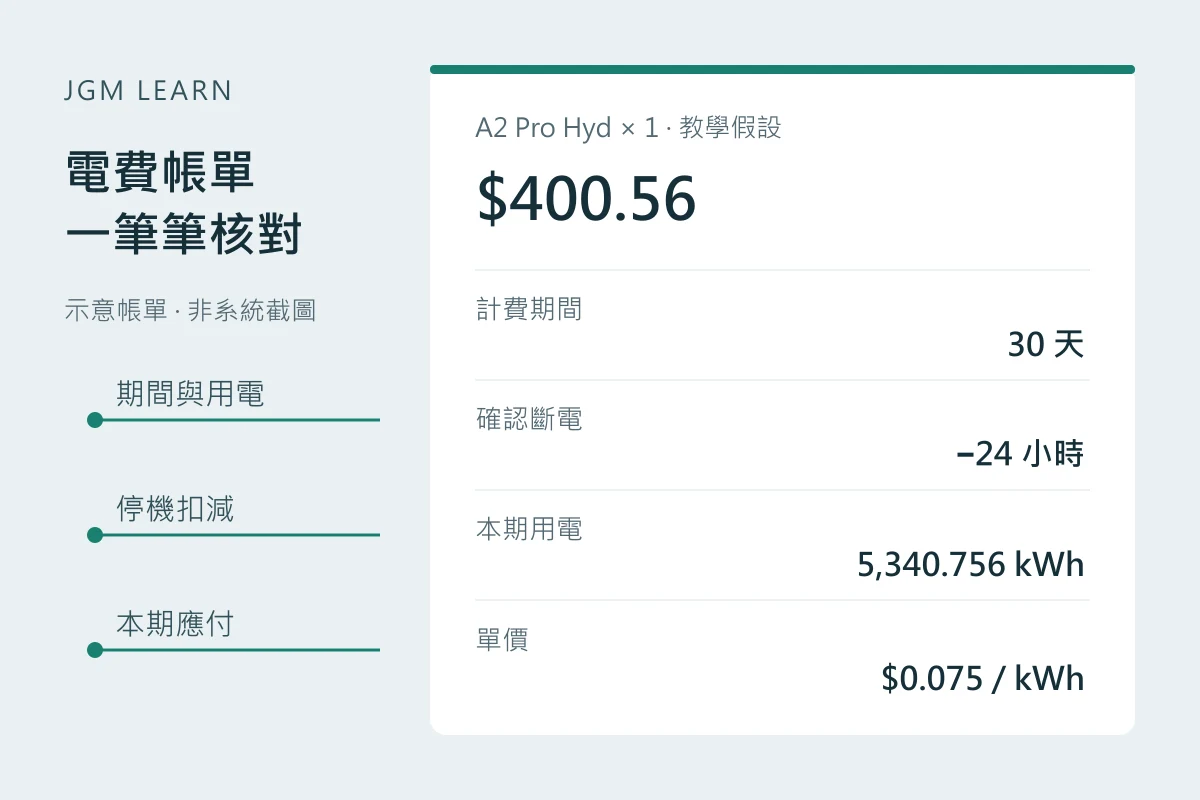
What is due on this invoice?
Assume billing uses agreed power and verified operating hours: one Bitdeer SEALMINER A2 Pro Hyd 500 TH/s version, using its rated 7.45 kW as a billing assumption, $0.075/kWh, plus one 3% loss adjustment. The 30-day period includes 24 hours fully powered off, with the provider confirming a full variable-power credit. No separate management fee is charged.
SEALMINER A2 Pro Hyd × 1
- Billing period
- 30 days · 720 hours
- Full-period energy (3% included once)
- 5,524.920 kWh
- 24-hour power-off credit
- −184.164 kWh
- Billed energy
- 5,340.756 kWh
- Tariff
- $0.075 / kWh
Separate deposit: $200 already held, not applied to this invoice or included in the amount due.
$414.37 is the full-period amount before downtime. The confirmed 24-hour power-off credit is $13.81, leaving $400.56 due. Energy calculations retain precision; monetary amounts are rounded to two decimals at the end.
Check the period, then the energy basis
This example runs from 00:00 on the first day of a month to 00:00 on the first day of the next, totaling 30 days and 720 hours in one site timezone. Mid-month deployment starts from the actual billing start. Split a cross-month shutdown between the relevant billing periods.
This invoice uses agreed power multiplied by time, not meter readings. The 7,450 W manufacturer rating applies to the 500 TH/s example, checked September 11, 2026. Rated power helps with selection and estimates; actual power and billing must follow the delivered version, operating mode, site measurements and agreed terms. For metered billing, check opening and closing readings, assigned equipment and the billing boundary; do not multiply measured kWh by rated power again. Official Bitdeer A2 Pro Hydro specifications ↗A2 Pro Hyd specifications and estimate ↗
Wall power and losses can differ between sites for the same model. Power infrastructure, wiring, operating mode, and allocation of pump and cooling electricity affect the billing boundary. The 3% here is an illustrative assumption, not a universal site allowance. At delivery, agree where power is measured, whether cooling is included, and whether losses are added separately or included in the tariff; reconcile subsequent bills on that basis.
First calculate device energy: 7.45 × 696 = 5,185.200 kWh. One 3% loss adjustment gives 5,340.756 kWh billed. If the quote or metered boundary already includes the same loss, use that basis without adding it twice. Check the billing terms of a hosting quote ↗
Match downtime credits to power-off records; keep the deposit separate
A pool reporting 95% hashrate achievement could reflect lower effective hashrate or network interruptions while the device still consumes power. This example credits a verified 24-hour full power-off period, not a pool percentage. Ask how disconnected, underclocked or reserved-capacity periods are billed under your agreement.
Assume a $200 deposit was already paid and remains intact, with none applied to this bill. It is recorded separately; the amount due remains $400.56. Do not add or independently deduct $200. If a deposit is applied, reconcile the credit with the remaining deposit balance.
Keep the quote, invoice and power records together
Ask specific questions: which shutdown period produced 696 billable hours? Is the 3% already included in the tariff or energy? This gives the provider a concrete item to reconcile. Check the invoice currency before payment; USD, USDT and local currency follow the agreed conversion basis.
The public Hub demo shows billing periods, miners, billed kWh, tariffs and historical totals using fictional data. Our downtime-credit and deposit annotations are teaching items, not a claim that the demo has identical fields. Learn and Hub both belong to JGM. Hub supports record viewing and service coordination; actual power billing follows the partner provider invoice. View the public Hub billing demo ↗
Use the cost tool to estimate next month. To explain falling after-power earnings, examine the bill alongside BTC production. Estimate with your electricity rate ↗Why the same miner earns less ↗From deploying one miner to paying the bill ↗
Connect electricity use with its supply
- Understand Energy and Computing Conversations: Essential Terms
Distinguish gas labels, generator types and units such as kW and kWh.
- How to Read a Gas-Power Quote: Costs and Conditions to Clarify
Check fuel, net output, maintenance and outage boundaries before comparing quotes.