

Can You Use Mining Heat? Start with Heat Demand and Operating Conditions
Mining equipment produces heat. Reusing heat that would otherwise be rejected for space heating, preheating or another demand is the idea behind heat reuse. But available heat does not necessarily match a need. Establish the heat demand before buying equipment and looking for a use afterward.
Separate three questions: whether the heat is useful, what happens when equipment stops, and which expense is actually avoided. Use your own heat-demand records to understand an offer before seeking a qualified assessment.
First published:(Taipei)
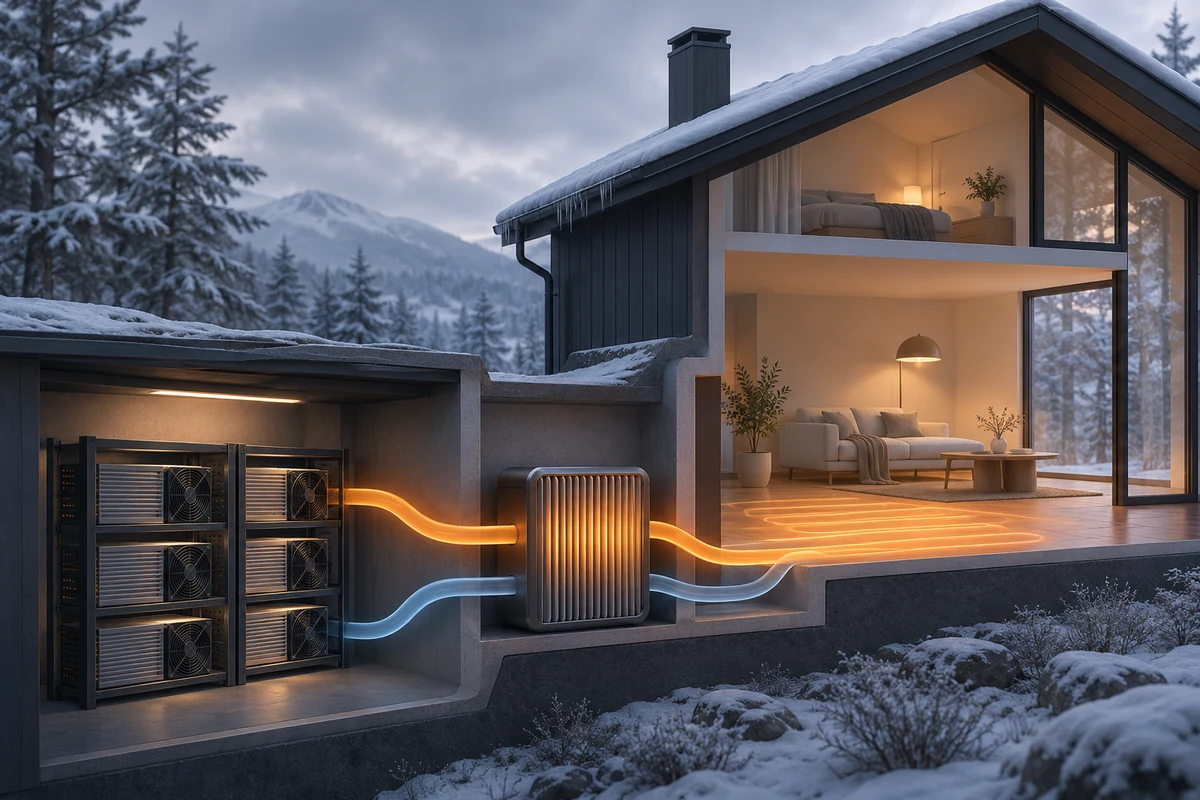
Quantity, temperature and timing must fit together
Quantity describes available energy; temperature affects what it can serve. Warm water may not directly replace a higher-temperature source. Even apparently sufficient energy may need additional equipment or be unsuitable. Miner power alone cannot establish recovery value.
Then examine timing. Winter space heating, intermittent hot water and year-round pools are different demands. Mining operation and heat use may not coincide. Record the hours, temperature, existing source and actual bill to identify what might be displaced. Storage is an option to assess, not a free or unlimited solution.
Miner power is not useful heat delivered to a room
kW measures power; kWh measures energy over time. If a hypothetical device draws a constant measured 3 kW for eight hours, it consumes 24 kWh. This is arithmetic, not a hardware test, and does not show that 24 kWh of useful heat reaches the room. Power (kW / MW) ↗Electrical energy (kWh) ↗
Check whether heat is collected, exchanged and delivered, and what is lost along the way. Include pumps, fans and controls; longer distances can add distribution, insulation and service needs. Before comparing recovery rates, establish the measurement locations, equipment boundary and whether the figure means heat produced or heat actually used.
A different heat user needs a different assessment
Do not begin with a universal floor-area claim. Insulation, climate, hot-water use and the existing system affect demand. A supplier’s area or temperature example is not a design basis for another building. Establish the following differences before seeking a qualified assessment.
| Use | Establish first | Often overlooked |
|---|---|---|
| Space heating | Season, hours, temperature and existing system. | Mining still needs heat rejection outside the heating season. |
| Hot water or preheating | Volume, peak timing, temperature and backup heat. | Equipment-loop fluid is not automatically domestic-use water. |
| Pools or ongoing process heat | Annual load, distance, heat exchange and service responsibilities. | A pool’s existence does not prove it can absorb all available heat. |
Have appropriately qualified people verify heat exchange, water separation, electrical capacity and local requirements. This guide provides no plumbing, wiring, fluid recipe or hygiene-compliance conclusion. Miner coolant requirements are not drinking-water or pool-water standards.
No heat demand and no mining operation are different problems
If mining continues when heat is not needed, it still requires model-appropriate heat rejection. Routing hot water elsewhere does not remove that responsibility. Conversely, if a miner fails, needs maintenance or stops mining, does the heat user still need heating? If so, the offer must address backup and switching. Understand the miner’s maintenance requirements ↗
Ask for separate explanations of both states: how equipment rejects heat when demand stops, and what supplies the heat user when mining stops. Clarify switching, maintenance, site response and cost responsibility. Year-round hashing does not establish year-round useful heat or heat income.
Separate avoided heating costs from mining revenue
Start with the heating expense actually displaced. Without an existing demand, theoretical heat output is not automatically a saving. Preheating may still need the original source to finish the job. Do not count the same saving once as reduced mining electricity and again as separate revenue.
Compare the same period with and without recovery. Include added equipment and installation, auxiliary power, maintenance, backup and downtime, and distinguish an existing miner from a new purchase. Show pool revenue separately with its price and production uncertainty; it should not hide the heating system’s own costs.
This is not a universal payback formula. Establish a baseline from your actual bills, then clarify the measurement boundary, heat-use period and included costs instead of accepting a two-returns-for-one-bill claim. Understand electricity and billing boundaries ↗
Use this checklist to compare an offer
You do not need to choose hardware first. Record the existing heating conditions and ask the provider to address each item. Gaps show where metering, a quote or qualified assessment is needed. Do not copy another site’s machine count or floor-area claim.
- Demand: what supplies heat now, in which months and hours, and at what temperature?
- Boundary: where is heat measured and delivered, and which auxiliary equipment and costs must be included?
- Interruption: how is heat rejected without demand, how is heating maintained without mining, and who is responsible?
- Accounts: which heating expense is actually displaced, and what is added compared with no recovery?
Sources and scope
Foundational reading: Learn’s energy terms and electricity-bill guide explain power, energy and billing boundaries. The 3 kW, eight hours and 24 kWh here are an arithmetic example, not equipment measurements or market quotes. Understand power, energy and efficiency ↗Electricity and billing boundaries ↗
Technical references, checked 2026-11-15 (Taipei): Australian Government guidance informs metering, distribution and maintenance questions; section 2 of the DOE-sponsored March 2008 study distinguishes heat quantity and temperature. Industrial efficiencies, prices and case results are not applied to miners, nor do these documents grant local engineering approval. Australian Government: waste heat recovery ↗DOE study: heat quantity and temperature (section 2) ↗
Further viewing: the HEATCORE and Jack conversation was originally broadcast on 2025-02-28; the 43:07 highlight was published on 2026-11-11. It presents a manufacturer’s experience and product observations. Area, price, staffing and reliability statements are not used as general data here or presented as independent Learn testing. Further viewing: mining heat and heating demand ↗
Manufacturer specifications identify model and fluid boundaries, not a product recommendation. This guide helps readers understand offers and ask questions; it provides no engineering design, guaranteed sizing, compliance conclusion or earnings promise, and is not investment advice. Official S21 XP Hyd. operating requirements ↗