

Why Does Bitcoin Mining Income Fall? Follow One Miner
The same S21 XP leaves about $4.01 a day after electricity in one scenario, but only $1.21 in another. Start by separating how much BTC it produces from what that BTC is worth.
This is a teaching example, not last month versus this month in a real account. Hardware and power conditions stay fixed; only BTC output and valuation change.
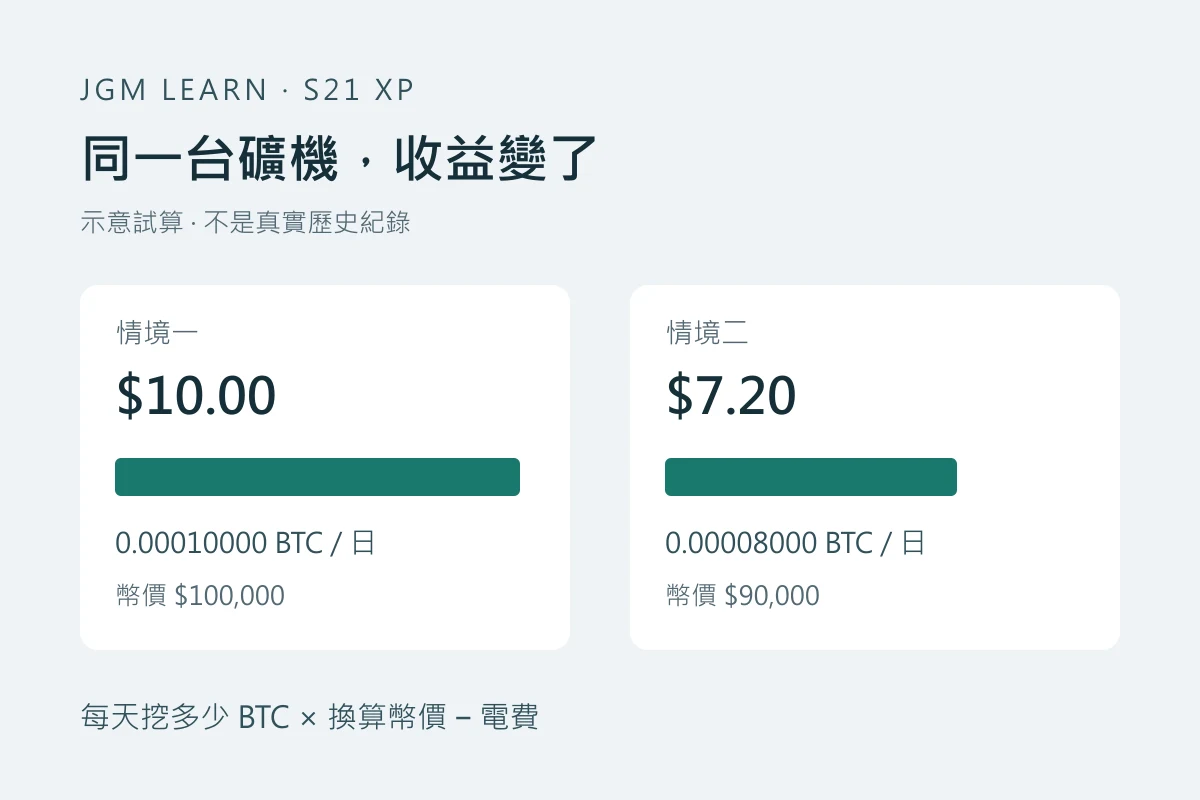
Put the two daily results side by side
The example uses an S21 XP rated at 270 TH/s and 3,645 W, with the manufacturer specifying power at 25°C. It is also the US-hosting model in our one-miner guide. This article uses the hardware for teaching, not a partner earnings record. Specifications checked September 11, 2026. Official BITMAIN S21 XP specifications ↗The one-miner hosting process ↗
Both scenarios use a 4% pool fee and 95% revenue uptime. Separately, billable running time is assumed to be 95%, with no variable electricity charged during shutdown. Electricity is $0.07/kWh with one 3% overhead adjustment. These are teaching assumptions, not a current hosting quote. BTC amounts already include pool fees and uptime.
| Measure | Scenario one | Scenario two |
|---|---|---|
| BTC per day | 0.00010000 BTC | 0.00008000 BTC |
| Valuation price | $100,000 | $90,000 |
| Converted income | $10.00 | $7.20 |
| Electricity | $5.99 | $5.99 |
| After-power earnings | $4.01 | $1.21 |
Daily after-power earnings fall by $2.80 while electricity stays unchanged. BTC output drops 20% and the valuation price drops 10%, together reducing income from $10 to $7.20. The result values BTC at the stated price and subtracts power; holding the BTC does not generate that cash payment.
First: why is daily BTC output lower?
Think of the miner as doing the same amount of computation each day. A higher effective network difficulty reduces its theoretical chance of earning a block reward. With effective hashrate, rewards and other conditions fixed, a 25% difficulty increase makes output 1 / 1.25, or 80% of the original. That is the illustrative basis for changing 0.0001 BTC to 0.00008 BTC above. See the yield calculation ↗
Increasing network hashrate can lead to a later difficulty adjustment; compare results against the difficulty already in effect. Transaction fees in blocks and pool settlement rules can also change income. This example holds them fixed to isolate difficulty. For your own records, compare settled BTC from the same pool over matching durations. Check network difficulty and hashrate ↗Understand pool settlement and payouts ↗
Then: what are those BTC worth today?
First lower output but keep the price at $100,000: 0.00008 BTC is worth $8. Only after changing the price to $90,000 does it become $7.20. Of the $2.80 income reduction, $2 comes from lower output and $0.80 from price. Separating the steps reveals the cause.
Lower output can also coincide with a higher BTC price. The same 0.00008 BTC valued at $125,000 is again worth $10. This is a price scenario, not a forecast, and shows why BTC quantity and dollar earnings deserve separate columns.
Keep the BTC, but budget for monthly power bills
You can keep mined BTC in your own wallet and sell in stages rather than selling each day. The dollar figures above are valuations for comparison. Cash proceeds depend on the execution price and fees when you sell. A later price rise increases the value of accumulated BTC; a fall reduces it.
With scenario two unchanged for 30 days, production totals 0.0024 BTC and electricity costs about $179.76. You can pay that bill from other cash or by selling part of the BTC:
| Arrangement | Hold all BTC | Sell enough for power |
|---|---|---|
| BTC mined | 0.002400 BTC | 0.002400 BTC |
| Power bill | $179.76 | $179.76 |
| BTC sold | 0 BTC | Approx. 0.001997 BTC |
| Other cash needed | $179.76 | $0 |
| BTC retained | 0.002400 BTC | Approx. 0.000403 BTC |
Holding every coin requires other cash for electricity; selling for the bill leaves fewer BTC. If the BTC price falls, the same dollar bill requires selling more BTC. Decide how many months your cash can cover before choosing how much to hold. These figures assume fixed conditions; check actual monthly production and electricity against your records.
What happens to this batch of BTC as its price changes?
Assume you keep all the coins and pay the $179.76 electricity bill for these 30 days from other cash. Your wallet holds 0.0024 BTC. Set aside any later mining output and follow just this batch:
| Later BTC price | Batch value | After this power bill |
|---|---|---|
| $60,000 | $144.00 | −$35.76 |
| $90,000 | $216.00 | $36.24 |
| $120,000 | $288.00 | $108.24 |
| $150,000 | $360.00 | $180.24 |
The same BTC is worth $216 at a $90,000 price and $360 at $150,000. The electricity already paid for this batch stays unchanged, so the after-power balance rises from $36.24 to $180.24. At $60,000, however, the coins are worth less than the electricity paid to produce them.
For a long-term holder, mining can provide ongoing BTC accumulation with control over when to sell. You retain coins rather than fixing the dollar result on the day they are mined. Having cash for monthly electricity is what lets you keep that choice instead of depending on a future price rise.
This table subtracts only electricity for this batch, excluding equipment purchase, repairs, sale and transfer fees. Cash proceeds depend on actual execution when sold. Future output changes with difficulty, halvings and operating conditions, so this 30-day BTC amount should not be projected unchanged indefinitely.
Apply the same sequence to your records
If pool hashrate is the first number to drop, check the measurement window and individual worker records before comparing income. Investigate low pool hashrate ↗
Compare settled BTC over equal durations, then check the valuation price and finally the electricity bill. Similar BTC but lower dollar income points first to price. Unchanged gross income but lower after-power earnings points to the bill. Pool payment dates are not daily production: thresholds and payout schedules can make wallet receipts uneven.
Enter your own rate on the S21 XP page for a consistent current estimate. Use the invoice example to check a bill, and the profitability guide for a broader cost assessment. S21 XP specifications and earnings estimate ↗Estimate with your electricity rate ↗Check an electricity invoice ↗Bitcoin mining profitability ↗